Renewable Energy Workbook
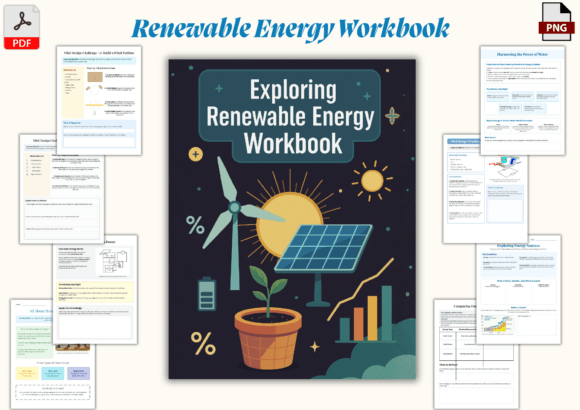
If you're designing for impact—whether it’s a classroom handout, a homeschool curriculum kit, a nonprofit’s environmental outreach campaign, or a small publisher’s STEM resource line—the Renewable Energy Workbook stands out not just for its content, but for how thoughtfully its visual language supports learning. This isn’t a static PDF full of dense text and clipped diagrams. It’s an 8.5 x 11 inch educational tool built with intention: vibrant color blocking, clean iconography (☀️💨💧), balanced white space, and layered typography that guides young eyes—and adult facilitators—through concepts without overwhelm.
The workbook’s personality is warm, grounded, and quietly confident. It avoids cartoonish exaggeration while staying far from clinical textbook austerity. Think illustrated flowcharts with soft-edged solar panels, wind turbine schematics drawn in approachable line art, and water cycle diagrams that breathe—not shout. Its visual rhythm comes from consistent spacing, purposeful use of bold sans serif headings paired with friendly, slightly rounded body type, and strategic bursts of color that signal activity types (blue for hydro experiments, amber for solar challenges). That consistency isn’t accidental—it’s design discipline applied to pedagogy.
This kind of visual coherence matters deeply across creative workflows. For educators building lesson plans, the workbook’s layout serves as a ready-made template for structuring inquiry-based activities. For marketers launching an eco-education brand, its aesthetic offers immediate reference points for tone-of-voice alignment, social media graphics, and even packaging design for printed kits. Bloggers covering sustainability education can lift its icon style or color logic into infographics. Publishers evaluating supplemental STEM materials notice how its editorial design balances clarity with engagement—no section feels like filler; every page invites interaction.
Where Visual Clarity Meets Real-World Use
Unlike fonts or templates designed solely for decoration, the Renewable Energy Workbook functions as a multi-surface design asset. Its grid system translates cleanly to digital slide decks for virtual classrooms. Its icon set scales well for Instagram carousels explaining energy basics. Its reflection prompts (“What would happen if your town switched entirely to wind power?”) are written with enough nuance to work in print journals, interactive web forms, or even QR-linked audio reflections.
You’ll see this strength most clearly in contexts where trust and accessibility intersect: school district procurement teams scanning for ADA-compliant readability, homeschool parents printing single pages on home inkjets, or community organizers adapting activities for multilingual learners. The workbook uses high-contrast type, generous line height, and chunked text blocks—not because it follows a checklist, but because its creators understood that comprehension starts with legibility, not cleverness.
Designing With Intention, Not Just Aesthetics
When you’re selecting resources like this one—especially for commercial or public-facing projects—look beyond surface appeal. Ask: Does the visual hierarchy support the user’s next step? Are diagrams labeled clearly enough for self-guided use? Is there room to annotate, or does the layout feel too precious to write on? The Renewable Energy Workbook answers “yes” to all three. Its guided reflections include lined spaces, not just blank margins. Its experiment instructions use numbered steps with corresponding icons—not just paragraphs. And its comparison charts (renewable vs. nonrenewable energy) rely on side-by-side visuals rather than dense tables.
That attention extends to format flexibility. The PDF version preserves vector-quality diagrams at any zoom level; the PNG files allow easy layering into Canva or Figma projects without font licensing concerns. No hidden rasterization traps. No missing glyphs when copying text. It behaves predictably—because it was built by someone who’s shipped print runs, run Zoom-based science camps, and watched kids actually *use* the thing.
Practical Fit Over Trendy Flash
Before adding the Renewable Energy Workbook to your toolkit, consider your actual workflow—not what looks good on a mood board. If you’re developing a series of climate literacy modules, its modular activity structure lets you pull individual experiments without disrupting continuity. If you’re a content creator scripting YouTube shorts on renewable tech, its simplified diagrams are ideal source material for quick explainer animations. If you’re a small business owner offering after-school STEM clubs, its ready-to-print format cuts prep time significantly—no reformatting, no font substitutions, no guessing whether that “eco-green” swatch will print accurately.
It also pairs intuitively with common design systems. Its primary heading type sits comfortably beside Montserrat or Inter in digital interfaces. Its illustration style complements Proxima Nova in presentation decks. Even its color palette—sunrise orange, sky blue, river teal—works within accessible contrast ratios against off-white or light gray backgrounds. None of this is accidental. It reflects awareness of real constraints: tight budgets, mixed device access, varying printer capabilities, and the cognitive load of switching between platforms.
Why This Resonates Beyond the Classroom
What makes the Renewable Energy Workbook valuable to designers, publishers, and marketers isn’t just that it teaches energy concepts—it’s that it models how to communicate complexity with grace. In an era of information overload, its restraint is radical. It doesn’t cram more onto a page; it asks better questions. It doesn’t prioritize novelty over function; it prioritizes understanding over speed.
That mindset transfers directly to branding work, editorial strategy, and product development. When you study how it introduces hydroelectric power—not with jargon like “potential energy conversion,” but with a cutaway drawing of a dam and a prompt asking students to trace water’s path—you’re seeing applied user-centered design. When you notice how its glossary definitions appear inline rather than footnoted, you’re seeing thoughtful information architecture.
For anyone building resources that need to educate *and* endure—whether that’s a seasonal newsletter series, a grant-funded curriculum, or a boutique publishing imprint—the Renewable Energy Workbook offers more than content. It offers a quiet masterclass in making meaningful things, clearly.