The Human Body Workbook
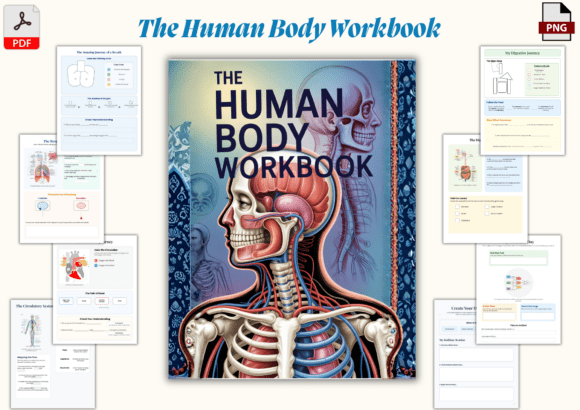
Understanding how your body works isn’t just for medical students or biology majors anymore—it’s become a quiet but powerful part of modern self-literacy. In a world where health decisions happen daily—what to eat, when to rest, how to move, whether to seek care—the ability to interpret basic anatomy and physiology matters more than ever. That’s where The Human Body Workbook steps in: not as a dense textbook or clinical reference, but as a vibrant, 18-page interactive PDF PNG printable designed to meet learners where they are—whether that’s at a kitchen table homeschooling a curious 10-year-old, guiding a middle-school science unit, or reflecting quietly on personal wellness habits.
Why Anatomy Is No Longer Optional Knowledge
Anatomy used to live in lecture halls and cadaver labs. Today, it lives in our fitness apps, nutrition trackers, telehealth consultations, and even social media infographics about gut health or stress responses. People aren’t waiting for formal instruction to ask questions like, “Why do I feel tired after lunch?” or “How does deep breathing actually calm my nervous system?” This shift reflects broader changes—not just in education, but in how we relate to our own bodies. We’re moving from passive recipients of health information to active participants in understanding cause, effect, and interconnection.
The Human Body Workbook responds directly to that shift. Its 8.5 x 11-inch layout is intentionally print-friendly and screen-optimized—designed for flexibility across workflows. A teacher might project a circulatory system diagram during a lesson, then hand out the matching labeling worksheet. A parent could print two copies—one for their child, one for themselves—and work through the digestion challenge side by side. A freelancer managing chronic fatigue might use the healthy habit tracker not as a rigid checklist, but as a gentle, visual way to notice patterns between sleep, hydration, and energy levels.
A Workbook Built for Real Lifestyles—Not Just Classrooms
What makes The Human Body Workbook stand out isn’t just its colorful diagrams or clear explanations—it’s how those elements serve actual human behavior. Consider the rise of hybrid learning: educators juggle in-person, remote, and asynchronous instruction. Homeschool families balance curriculum with real-life responsibilities. Creators and content professionals need reliable, adaptable resources they can embed into newsletters, courses, or client workshops—without licensing hurdles or platform lock-in.
This workbook meets those needs by being both tactile and digital-ready. The PDF PNG format means it renders consistently across devices, supports annotation tools (like Apple Pencil or stylus input), and prints crisply on standard home or office printers. There’s no subscription, no login wall, no forced app integration—just immediate access and full ownership. That kind of autonomy aligns with growing user expectations around digital products: simplicity, portability, and respect for time and attention.
From Passive Learning to Embodied Understanding
Traditional health education often treats the body as a collection of isolated parts—heart here, lungs there, stomach over there. But lived experience tells us otherwise. We feel the link between breath and anxiety. We notice how muscle tension shifts with emotional stress. We see how digestion affects focus and mood. The Human Body Workbook leans into that reality by emphasizing systems thinking—not just naming organs, but inviting reflection on how they communicate, compensate, and collaborate.
Take the respiratory and circulatory systems page: it doesn’t stop at labeling the diaphragm or tracing blood flow. It includes a guided prompt: *“Draw one thing you did today that helped your lungs and heart work well together.”* That small nudge transforms abstract knowledge into personal relevance. Similarly, the immunity section pairs a simplified illustration of white blood cells with a journaling space titled *“When did my body protect me this week—and how did I support it?”* These prompts don’t assume expertise—they invite observation, curiosity, and agency.
Practical Integration Across Roles
For educators, The Human Body Workbook functions as a low-prep, high-engagement supplement. It fits seamlessly into NGSS-aligned units, STEM fairs, or health literacy initiatives—no special materials required beyond paper, pencils, and maybe some colored markers. For homeschoolers, it offers structure without rigidity: lessons can be spread across days, revisited seasonally, or paired with kitchen experiments (like modeling digestion with baking soda and vinegar).
For creators and marketers, the workbook presents an opportunity to deepen audience trust. A wellness coach might include a customized version of the habit tracker in a free lead magnet. A science communicator could adapt one of the reflection prompts into a newsletter question that sparks meaningful replies. Even business owners in adjacent spaces—yoga studios, physical therapy clinics, functional nutrition practices—can offer it as a thoughtful onboarding tool for new clients, reinforcing foundational knowledge before diving into personalized plans.
What Has Changed—and Why Now?
Interest in bodily literacy has grown alongside several converging trends: the normalization of mental and physical health conversations; increased access to wearable biometrics (which only matter if you understand what the data means); and a broader cultural pivot toward preventative, rather than reactive, care. At the same time, attention spans have shortened, and trust in institutional sources has softened—making approachable, creator-made resources like The Human Body Workbook more valuable, not less.
It’s also worth noting how digital fatigue has reshaped preferences. People still want rich, visual learning—but they increasingly prefer resources they can control, pause, annotate, and return to—not autoplay videos or algorithm-driven feeds. This workbook honors that preference: no sound, no ads, no tracking—just focused, intentional interaction with foundational science.
Not Just for Kids—A Tool for Lifelong Curiosity
While marketed with students and teachers in mind, the design principles behind The Human Body Workbook resonate strongly with adults relearning or expanding their health knowledge. Many professionals—especially those in creative, caregiving, or service-oriented fields—spend years supporting others’ wellbeing while neglecting their own foundational understanding. A graphic designer managing autoimmune symptoms. A writer researching a health-related book. A small-business owner navigating burnout. These are the quiet audiences who benefit most from clear visuals, nonjudgmental language, and space to reflect—not memorize.
The inclusion of real-world science activities—like mapping daily movement patterns or observing how posture shifts during different tasks—makes anatomy tangible. You don’t need a lab coat or microscope. You need curiosity, a few minutes, and something to write with. That accessibility is rare—and increasingly necessary—in a landscape crowded with oversimplified hacks and overly technical jargon.
A Thoughtful Bridge Between Science and Self-Care
In the end, The Human Body Workbook succeeds because it refuses to choose between rigor and warmth. It doesn’t dumb down science—but it does remove unnecessary barriers to entry. It doesn’t promise transformation—but it does create conditions where understanding can take root and grow. Whether used once a week in a classroom, revisited monthly in a wellness practice, or gifted as a meaningful resource to someone beginning their health journey, it serves a simple, enduring purpose: helping people see themselves—not as problems to fix, but as complex, dynamic, deeply intelligent systems worthy of attention and care.
That kind of grounded, human-centered science education isn’t just timely—it’s essential. And sometimes, it starts with an 18-page printable, a pencil, and the quiet decision to look closer.