When Time Stood Still for Love
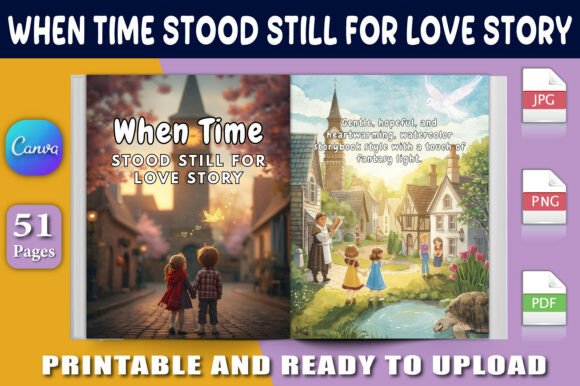
“When Time Stood Still for Love” isn’t a font—it’s a picture book. A tender, magical realism story for children aged 6–8, where a frozen clock tower in Willowbrook becomes the quiet catalyst for emotional growth, kindness, and friendship. Visually, it leans into soft watercolor textures, gentle line work, and a warm, unhurried palette—think muted golds, sky blues, and parchment creams. The illustrations breathe; they pause. Every page invites slow looking—not because the story moves slowly, but because it asks readers to feel deeply before turning.
The book’s personality is calm but never passive. It carries the quiet confidence of stories that trust children to sit with ambiguity—to wonder why time stopped, and what love has to do with gears, gratitude, or a shared loaf of bread from Mrs. Chen’s bakery. Its voice is kind without being saccharine, wise without lecturing, and magical without losing grounding in real human moments: Leo tightening a loose hinge on the library door, Emma leaving wildflowers at the park bench for someone who looks lonely.
This isn’t high-contrast fantasy or fast-paced adventure. It’s editorial design with heart—structured like a gentle rhythm: pause, reflect, connect. That intentionality extends to every visual decision, from the delicate feather motif (🪶) tracing the edge of a spread, to the subtle shimmer (🌟) marking moments when kindness shifts something invisible but real.
Where This Story Lives Best—Beyond the Page
Because “When Time Stood Still for Love” is built on emotional resonance—not just plot—it translates powerfully across creative and commercial contexts where authenticity matters. Designers use its visual language in brand identities for mindful wellness studios, small-batch bakeries, or community libraries aiming to signal warmth over efficiency. Marketers working with early-childhood education platforms pull its color harmonies and symbolic motifs (🕯️, 🕊️, ❤️) into social media graphics that avoid cartoonish tropes while still feeling joyful and age-appropriate.
In publishing, it’s a quiet standout on bookstore shelves—not loud, but *noticed*. Its cover doesn’t shout; it beckons. That makes it ideal for indie publishers building curated lists focused on emotional literacy, neurodiversity-affirming narratives, or intergenerational storytelling. Print designers appreciate how its restrained layout leaves room for breathing space—no overcrowded text blocks, no frantic typography. Instead, short lines, generous margins, and intentional pauses echo the story’s central metaphor: time as something felt, not measured.
Why Visual Consistency Matters More Than You Think
Readability here isn’t about speed—it’s about safety. For young readers still building fluency and emotional vocabulary, consistency in visual tone reduces cognitive load. When the same golden bird (🕊️) appears across three key scenes—perched on the clock tower, resting on Emma’s shoulder, then flying above the rainbow trail (🌈)—it becomes an anchor. Not a decorative flourish, but a narrative thread. That kind of repetition builds recognition without repetition fatigue.
That same principle applies off the page. If you’re adapting “When Time Stood Still for Love” into a classroom resource kit, keeping the candle icon (🕯️) as the consistent marker for reflection prompts—or using the bread loaf (🍞) only where gratitude practices are introduced—creates intuitive navigation. It’s not branding for branding’s sake. It’s clarity earned through care.
Practical Pairings: Typography That Honors the Story
The book uses a custom serif face for body text—soft-edged, slightly rounded, with open counters and generous x-height. It’s legible at small sizes but never sterile. For display use—chapter titles, cover type, or endpapers—the team chose a light-weight sans serif with subtle calligraphic lift on ascenders. Not trendy. Not minimalist. Just *present*, like a trusted teacher’s handwriting on a whiteboard.
If you’re creating companion assets—a read-aloud video script, a printable kindness journal, or educator discussion cards—pair that serif with a friendly, low-contrast sans (think Quicksand or Nunito) rather than a rigid geometric. Avoid tight tracking or all-caps headlines. Let the words rest. Let them land.
And skip script fonts for anything functional. A handwritten style might seem “whimsical,” but it risks undermining readability for emerging readers or dyslexic audiences. “When Time Stood Still for Love” earns its magic through sincerity—not stylistic gimmicks.
Licensing, Adaptation & Real-World Use
As a KDP-published children’s picture book, “When Time Stood Still for Love” comes with standard commercial rights for resale and non-derivative use. That means you can confidently feature it in your newsletter, use its cover art in a blog post about emotional literacy resources, or reference it in a workshop slide deck—all without special permission.
But if you’re planning adaptations—like turning the Time Bird (🕊️) into a logo for a school counseling program, or designing merch based on the rainbow trail (🌈)—review KDP’s terms carefully. Derivative works require direct licensing. Better yet: reach out to the author/illustrator team. Many indie creators welcome thoughtful collaborations—especially when the intent aligns with the book’s core values: kindness, slowness, connection.
Test your usage early. Print a sample spread at actual size. View it on a tablet in daylight and under warm indoor lighting. Does the feather motif (🪶) still read clearly at 12pt? Does the candle’s glow (🕯️) hold up in grayscale? These aren’t nitpicks—they’re how respect for the story shows up in execution.
A Final Note on Quiet Power
“When Time Stood Still for Love” succeeds because it refuses to rush. In a landscape saturated with bright, bold, and busy, its restraint is its strength. That makes it unusually versatile—not as filler, but as foundation. Use it where you need meaning to linger. Where you want attention to soften, not sharpen. Where the goal isn’t to capture eyes, but to hold hearts.
Whether you’re choosing fonts for a client’s new mindfulness app, designing packaging for a small-batch tea line inspired by the book’s calm aesthetic, or selecting read-aloud titles for a pediatric waiting room—this story reminds us: some of the most powerful creative decisions are the ones that let time breathe.