2026 Student Organizer for Children
Imagine a planner that doesn’t just track deadlines—but grows with a child. The 2026 Student Organizer for Children is built on that idea: a thoughtfully structured, visually warm, and intentionally flexible tool that supports young learners as they develop autonomy, curiosity, and confidence. It’s not a rigid schedule or a miniature corporate dashboard—it’s a companion designed with developmental psychology in mind, wrapped in clean, joyful design.
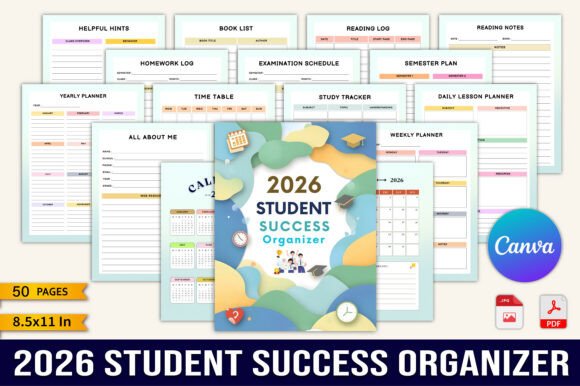
Visually, the organizer balances clarity and charm. Layouts use ample white space, soft rounded corners on icons and dividers, and a restrained but expressive color palette—think muted teals, warm terracottas, and gentle sage greens—not loud primaries. Typography is approachable: a friendly sans serif for headings (not too playful, not too clinical), paired with a lightly weighted, highly legible body type that works equally well in print and digital annotation. There are no distracting embellishments—just purposeful visual hierarchy, consistent spacing, and intuitive iconography that kids recognize at a glance.
More Than a Planner—A Scaffold for Learning Habits
This isn’t about filling in boxes. It’s about building routines that stick. The 2026 Student Organizer for Children introduces time management through repetition and reward—not pressure. Weekly layouts include gentle prompts (“What made me proud this week?”), while daily pages leave room for both structure (Math class → 10:30 a.m.) and spontaneity (“I drew a robot during science!”). The reading log doesn’t just ask for titles—it invites illustrations, favorite quotes, and “What I wonder…” notes. That subtle shift—from compliance to engagement—is where real habit formation begins.
The goal-setting sections avoid vague aspirations (“Be better”) and instead guide children toward concrete, observable actions: “I will raise my hand before speaking in circle time,” or “I’ll try one new vegetable each week.” These aren’t adult-imposed targets—they’re co-created, scaffolded, and revisited regularly using the year-end reflection pages. That reflection isn’t an afterthought; it’s built into the rhythm of the planner, reinforcing metacognition long before the term appears in a curriculum.
Design Flexibility for Real-World Use
Whether you're a small business owner selling printable planners on Etsy, a school counselor adapting resources for diverse learners, or a homeschooling parent customizing weekly rhythms—the 2026 Student Organizer for Children delivers practical versatility. The included Canva link isn’t just editable—it’s intelligently layered: color swatches are named and grouped, text boxes use paragraph styles, and layout grids stay locked unless intentionally adjusted. You can swap out book lists for your local library’s summer challenge, add bilingual headers for dual-language classrooms, or reformat project planners for STEM fair timelines—all without breaking alignment or readability.
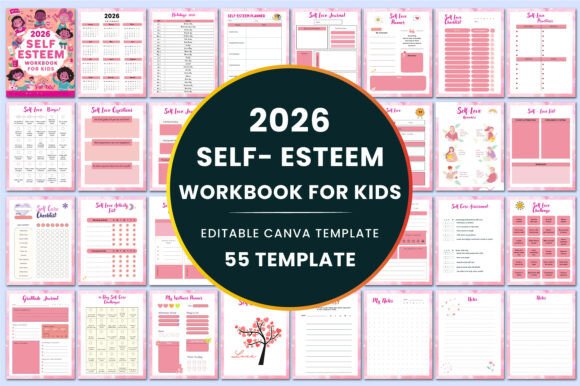
The 50 Canva templates aren’t variations on a single theme. They reflect real pedagogical needs: some emphasize visual schedules for neurodiverse learners; others simplify task breakdowns for early elementary; a few integrate SEL prompts aligned with CASEL competencies. Page size (8.5×11") ensures compatibility with standard printers and binders, while PDF files retain crisp vector-quality lines and embedded fonts—no pixelation, no font substitution surprises when opened on different devices.
Why This Works Where Others Fall Short
Many student planners default to either oversimplification (cartoonish, too young) or premature complexity (dense calendars, abstract tracking). The 2026 Student Organizer for Children lands precisely in the middle: it respects a child’s growing capacity for abstraction while honoring their need for tactile, visual, and narrative anchors. For example, the achievement reward tracker uses incremental badges—not just gold stars—but meaningful milestones tied to effort (“Asked a question in class three times”), persistence (“Revised my writing twice”), and collaboration (“Helped a friend understand the math problem”).
Similarly, the project lesson planners don’t just list steps—they include dedicated spaces for gathering materials, sketching ideas, noting questions for teachers, and reflecting post-presentation. That scaffolding mirrors how skilled educators actually support inquiry-based learning. And because all files are provided in both editable (Canva) and print-ready (PDF) formats, there’s no compromise between customization and reliability.
Practical Considerations for Creators & Educators
If you’re integrating this into your workflow—whether as a designer adding value to your client offerings, a blogger creating companion resources, or a publisher bundling with literacy programs—pay attention to three things:
- Licensing clarity: All assets are licensed for commercial use—including resale of printed copies and digital downloads—as long as you’re not reselling the Canva templates *as-is* without modification.
- Readability testing: Print a sample weekly spread at 100% scale and test with actual students. Observe where eyes linger, where hands hesitate, where pencil marks smudge. The best-planned layout fails if a third grader can’t find the “homework due” box without help.
- Pairing intentionality: When customizing in Canva, avoid stacking multiple decorative fonts. Stick to one primary sans serif for structure, one simple script only for section headers (e.g., “My Reading Log”), and let the content—not the typeface—carry the meaning.
This isn’t about making school “fun.” It’s about removing friction so learning can breathe. The 2026 Student Organizer for Children succeeds because it assumes competence, invites participation, and leaves room—for growth, for mistakes, and for the quiet pride of checking off a goal you set yourself.