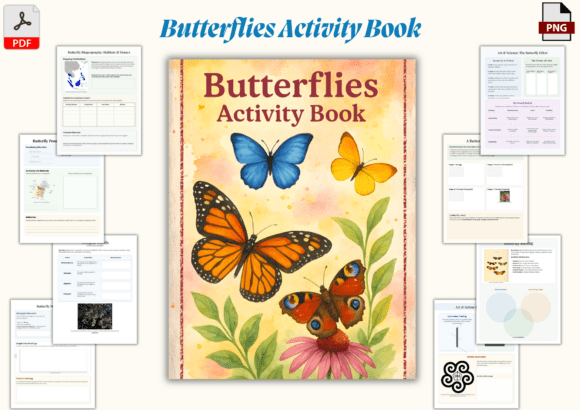
Butterflies Activity Book
If you’ve ever watched a child pause mid-sprint to crouch beside a milkweed plant, eyes wide as a monarch flutters past—or if you’ve tried to explain metamorphosis without losing your audience to screen glare—you know how rare it is to find a resource that’s equally grounded in science and spark. The Butterflies Activity Book isn’t just another printable—it’s a low-prep, high-engagement tool that meets kids where their curiosity lives: in color, motion, pattern, and wonder.
Where This Book Fits Into Real Life (Not Just Lesson Plans)
Teachers don’t just “use” activity books—they weave them into moments that matter. A third-grade science unit on life cycles becomes tactile when students trace the stages of a swallowtail, then sketch their own version of pupation using guided lines and watercolor-style outlines. In a rainy-day homeschool rhythm, it replaces 20 minutes of scrolling with focused pencil time: matching butterfly species to native plants, labeling wing parts, or recording real-time observations from a backyard netting session.
But its usefulness stretches far beyond the classroom. Therapists working with neurodiverse children use the mazes and tracing pages to build fine motor control without calling it “therapy.” Grandparents print a few pages before a visit—no prep, no mess, just shared focus over coloring wings while talking about the painted ladies they saw last summer. Nature centers tuck it into volunteer kits for family event days, pairing each completed page with a short walk to spot real-life parallels in the pollinator garden.
Why It Works When Other Resources Don’t
Most butterfly-themed printables fall into one of two traps: oversimplified (all butterflies look like rainbows with antennae) or overly technical (scientific names on every page, no visual scaffolding). The Butterflies Activity Book avoids both by anchoring learning in *recognition*, not rote memorization. Kids don’t just learn that butterflies taste with their feet—they’re asked to draw foot structures next to a labeled diagram, then circle which plants those feet might land on. That small shift—from passive reading to active connection—makes retention stick.
The 8.5 x 11-inch size isn’t arbitrary. It fits standard printers, laminators, and dry-erase sleeves—so teachers can reuse pages year after year. The 18-page count is intentional too: enough variety to sustain interest across multiple sessions, but not so many that it overwhelms a parent sorting through Monday-morning chaos. And because it’s delivered as a PDF + PNG set, users aren’t locked into one format. You can drop individual pages into digital learning platforms like Seesaw or Google Classroom, project a maze onto an interactive whiteboard, or print just the coloring sheets for a quiet corner during a library story hour.
Real Scenarios, Real Decisions
Imagine you’re a freelance educator designing a summer nature camp for ages 6–9. You need materials that scale across ability levels, require zero shipping, and align with NGSS standards on biodiversity and ecosystems. You open the Butterflies Activity Book, scan the habitat mapping page, and realize it pairs perfectly with a local park scavenger hunt—you’ll hand out printed maps, then let kids fill in real sightings with colored pencils. No extra lesson planning. Just clarity, continuity, and confidence.
Or picture this: You run a small Etsy shop selling nature-themed wall art. You want to add value to your listings—not with gimmicks, but with something meaningful. Bundling the Butterflies Activity Book as a free digital download with every framed butterfly print creates a tangible reason for customers to choose you over bigger retailers. It signals care—not just for aesthetics, but for the learning behind them.
Even bloggers and content creators find utility here. One wildlife photographer embedded three pages from the book into a blog post titled “What My Camera Can’t Capture About Butterflies”—using the anatomy diagrams and observation journal prompts to deepen reader engagement. The result? Longer dwell time, more shares, and a natural lead-in to her online workshop on macro insect photography.
What to Consider Before You Download or Share
This isn’t a plug-and-play curriculum replacement—but it *is* a powerful accelerator. If you’re looking for scripted lesson plans with assessment rubrics, you’ll need to layer those in yourself. That said, the structure invites adaptation: the data recording page works just as well for tracking fireflies or bumblebees, and the species comparison chart can be extended to moths or beetles with minimal tweaking.
Also worth noting—the illustrations use soft watercolor textures, not clipart. That aesthetic choice matters. It subtly teaches visual literacy: kids begin noticing gradients, negative space, and texture variation, which supports later art and science skills alike. But if your setting prioritizes bold, high-contrast visuals for accessibility (e.g., certain special education contexts), you may want to preview the sample pages first.
And while the book is designed for independent or guided use, its strongest impact happens when paired with real-world experience. Keep a magnifying glass nearby. Pause during walks to compare a drawn proboscis with what you see coiled under a zinnia. Let the activity book be the bridge—not the destination.
Who Benefits—and How It Shows Up Differently
- Classroom teachers use it to differentiate: advanced learners extend the life cycle diagram into a comparative study with moths; emerging readers focus on tracing and matching; ESL students build vocabulary through image-supported labels.
- Homeschoolers rely on it for “science on demand”—no lab setup needed, just curiosity and crayons. One parent reported her daughter started asking to revisit the same page weekly, adding new details each time—a quiet sign of deepening observation skills.
- Creative entrepreneurs repurpose the line art for embroidery patterns, SVG files for cutting machines, or even coloring book apps—thanks to clean, scalable PNGs included in the download.
- Nature communicators (park rangers, museum educators, podcast hosts) pull single pages for social media—“Can you spot the difference between a skipper and a sulphur?”—driving traffic back to longer-form content.
The Butterflies Activity Book doesn’t promise transformation. It offers something quieter, and more reliable: a way to turn passing fascination into lasting attention—to help kids (and the adults guiding them) slow down long enough to see the iridescence in a wing scale, the precision in a proboscis coil, the quiet miracle in a chrysalis hanging still on a twig. That kind of attention doesn’t come from screens. It comes from paper, pencil, and permission to wonder—page by thoughtful page.