Elephants Activity Book: A Practical Learning Tool for Educators, Parents, and Young Nature Enthusiasts
For teachers juggling differentiated instruction, homeschooling families seeking meaningful screen-free engagement, and parents looking to nurture curiosity about wildlife—finding resources that are both educationally sound and genuinely engaging can feel like searching for a needle in a haystack. The Elephants Activity Book meets that need head-on: it’s not just another coloring workbook, but a thoughtfully structured, 18-page educational tool designed to support real learning outcomes while sparking wonder about one of Earth’s most intelligent species.
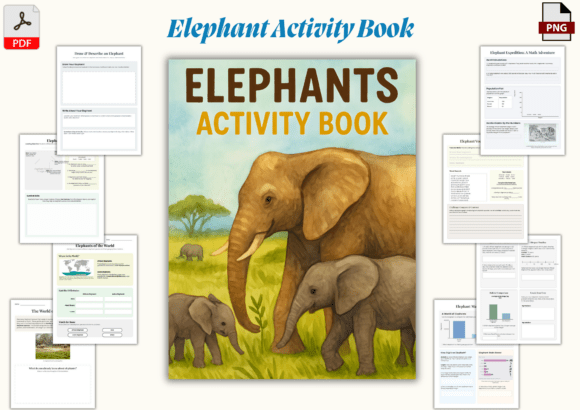
At its core, the Elephants Activity Book is a ready-to-use, printable resource—delivered as an 8.5 x 11-inch PDF and PNG set—that bridges science literacy, early STEM skills, and creative expression. Created by Nora’s Creations, it centers on elephants not as distant zoo exhibits, but as complex, socially rich animals whose survival is deeply tied to habitat health, human choices, and global conservation efforts. That focus makes it uniquely valuable—not only for building knowledge, but for cultivating empathy and environmental stewardship from an early age.
What Real Challenges Does This Resource Solve?
Educators often face three persistent challenges: aligning activities with curriculum standards (especially NGSS-aligned life science concepts), accommodating diverse learning styles without extra prep time, and maintaining student motivation during thematic units. Meanwhile, parents and homeschoolers may struggle with finding cohesive, low-cost materials that go beyond surface-level facts—and avoid overwhelming young learners with dense text or abstract concepts.
The Elephants Activity Book responds directly to these needs. Its 18 pages are intentionally paced and scaffolded: each activity builds on the last, moving from concrete observation (e.g., labeling elephant anatomy) to higher-order thinking (e.g., interpreting population data or evaluating conservation strategies). There’s no “busy work”—every page serves a clear purpose grounded in early elementary science and literacy goals.
How It Supports Meaningful Learning Outcomes
Unlike passive worksheets, the Elephants Activity Book invites active participation. Children draw trunk muscles to understand adaptation, plot migration routes on simplified maps to grasp geography, and use real-world elephant facts to solve basic math problems—like calculating how much food an adult African elephant consumes daily (up to 300 pounds!). These aren’t isolated exercises; they’re connected experiences that reinforce cross-curricular understanding.
For example, the “Habitat Match-Up” page asks learners to connect elephant species (African bush, African forest, Asian) with their native regions—and then consider why deforestation or poaching impacts each differently. That simple task introduces cause-and-effect reasoning, geographic awareness, and ethical reflection—all in under five minutes.
Similarly, the “Conservation Challenge” activity guides children to brainstorm solutions—like creating wildlife corridors or supporting community-led anti-poaching initiatives—then illustrate their idea. This nurtures problem-solving confidence and lays groundwork for future civic engagement, all while staying age-appropriate and solution-focused.
Practical Applications Across Settings
In the classroom: Teachers use the Elephants Activity Book as a flexible anchor for science units on animal adaptations, ecosystems, or endangered species. It works equally well as a center activity, morning warm-up, or end-of-unit review. Because it’s print-ready and standards-aligned, it saves planning time while delivering measurable skill practice in reading comprehension, data analysis, and fine motor development.
For homeschooling families: The book provides structure without rigidity. Many users report pairing pages with short documentaries (like BBC’s *Dynasties* clips) or local zoo visits—turning the activity book into a living journal of discovery. Its open-ended prompts (“Draw your own elephant habitat”) encourage extension projects, such as building dioramas or writing habitat protection letters to local representatives.
For parents and caregivers: It’s a trusted “rainy day” or travel companion—no devices required. One parent shared using the coloring pages during pediatric waiting rooms, noting how the factual captions (“Elephants communicate using infrasound—sounds too low for humans to hear!”) sparked spontaneous conversations about senses and sound waves. That kind of organic, curiosity-driven dialogue is exactly what research shows strengthens long-term retention and scientific identity.
Key Considerations for Best Results
While the Elephants Activity Book is designed for independent use, its impact multiplies when adults engage alongside children—not by giving answers, but by asking open questions: “Why do you think elephants have such big ears?” or “How might this map change if we added climate zones?” These interactions deepen conceptual understanding far more than completion alone.
Also worth noting: the book’s emphasis on all three elephant species helps counter common misconceptions. Many children (and adults!) assume “elephant” means one uniform animal. By highlighting physical differences, social structures, and distinct threats faced by African bush vs. forest vs. Asian elephants, the Elephants Activity Book builds nuanced, accurate mental models—essential for informed advocacy later in life.
Finally, because it’s delivered digitally, users can print single pages as needed—ideal for targeting specific skills (e.g., reinforcing graph-reading with the “Elephant Lifespan Comparison” chart) or adapting for mixed-age groups. Some teachers even laminate high-use pages for repeated use with dry-erase markers.
Why This Resource Stands Out Among Wildlife-Themed Materials
There’s no shortage of animal-themed printables online—but few integrate conservation messaging so authentically. Rather than tacking on a “save the elephants” message at the end, the Elephants Activity Book weaves it throughout: from discussing ivory trade history in age-appropriate language, to celebrating Indigenous-led conservation efforts in Kenya and Thailand. That authenticity resonates with today’s educators and families who want resources that reflect real-world complexity—not oversimplified narratives.
It also avoids “cute overload.” While beautifully illustrated, the art supports learning—not distraction. Trunk musculature is anatomically accurate; range maps use standard cartographic conventions; even the coloring pages include labeled features that reinforce vocabulary (e.g., “temporal gland,” “prehensile trunk”). This attention to detail signals respect for children’s capacity to understand sophisticated ideas when presented clearly.
If you’re looking for a resource that does more than fill time—if you want to build foundational science literacy, spark compassionate inquiry, and give children tangible ways to connect with the natural world—the Elephants Activity Book delivers. It’s practical, purposeful, and quietly powerful: a small tool with big potential for nurturing the next generation of thoughtful, informed stewards of our planet.